 Magic Water
So far we've learned a lot about water, how to design and animate it so let's apply some of that to a magical water effect.
This lesson marks the end of Level 9 and this effect will not be easy. There are levels of complexity you can choose from when doing magical elements and we could really go crazy with some intricate magical water. Let's start off with a modest water spell first, starting with how we might stylise water for a magic spell.
There are a number of questions that need answers before you start designing and animating your own magical effects. Depending on the effect, these questions will vary and you could ask a million of them. It's a good idea to narrow it down to just a few of the most broad and important questions, so for this one, let's ask the following and answer them in turn.
For the sake of demonstration, I'll be answering each of these questions for designing a magical water effect.
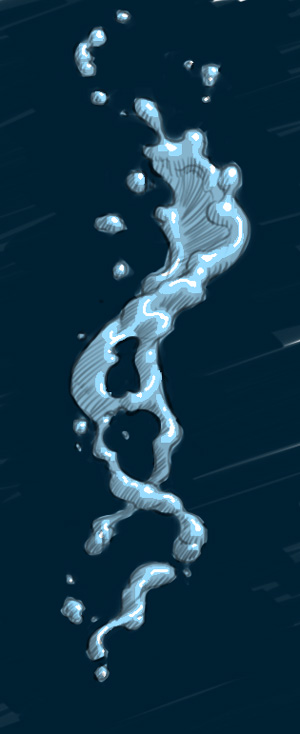
It sounds obvious, but whether it's your own project or you're working on this for someone else, it's important that you understand the reason the character would use this spell. Under what circumstances is the spell cast? Is it an offensive weapon or a defensive one? Perhaps it has no real use other than to entertain and inspire others, kind of like fireworks or those super huge bubbles you see people making with soap.
I've already established that my water spell will be used for entertainment, so it makes sense that the magician would weave it with some theatrics for performance value. Therefore, this spell might take its time building gradually from small, slow beginnings up to a crescendo of larger and more intricate watery shapes.
Magic can appear from a source, catalyst or other action. For example a fireball spell may come from an ignition or a flash. An earth spell may rise up from the ground around the wizard's feet. I've decided that this water spell will materialise from the magician's hand.
The only reason I added this question to the list is because I like the idea of scalding hot water as a weapon. Even for an entertainment spell, boiling water introduces a number of interesting FX layers, such as rapid bubbling, steam and sputtering.
Having said all that, my water spell will be lukewarm; neither hot nor cold. Partly for the sake of simplifying this exercise somewhat, and partly because an entertainment spell like this should probably be crowd-friendly. Kids may grab at it, or the magician may playfully splash the audience with it. We don't want to melt any faces or blind anyone just yet!
An entertainment spell wouldn't be very interesting if it didn't move. I have an idea that this particular effect will behave like a double-helix of water that spirals upward. The shapes will be thick and round, like those seen in a lava lamp.
Summing up:
A lukewarm water spell is gradually woven, materialising from the magician's hand to entertain (distract?) onlookers.
There's a couple of ways this spell can be approached. In the video below, I'll design a number of stages for the magical effect with its various layers.
video 36_majaqua2
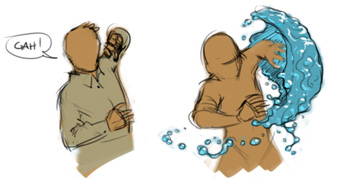
It's well worth considering that in order to defend an incoming attack, any defensive spell must materialise almost instantly. There may be exceptions though, perhaps such as a passive shield spell that is built up before the magician enters the fight.
Figure 1 (right) shows a natural defensive pose and how it may translate to a magical defence with a watery shield. Note the similarities in both, not just the position of the lead arm protecting the head, but also of the head position. It's being pulled back away from the attack so the chin is tucked into the neck and the whole head is nestled between the shoulders. Of course the main line of action is the bending back of the whole posture, away from the attack, but consider more a situation where the shield spell might be pushed forward, attacking the incoming spell, rather than just deflecting or absorbing it.
An offensive spell would also be quite fast. It could also possibly take a little more time than an emergency defensive spell, but the longer it takes to cast, the more it will telegraph the attack. A slowly cast offensive spell is probably best for an ambush, or perhaps an attack from behind.
Figure 2 (below) has two poses for a boxer, then illustrated beneath those are how those poses transfer to magic poses. Bear in mind that boxers have quick, light attacks as well as slower, heavy attacks. The jab and the hook, for example. An attack doesn't need to be fast and hard. Take an opportunity to incorporate some realism into your magic by having rules. The old rules of 'slow & heavy, fast & light' are good for magic animation design and timing.
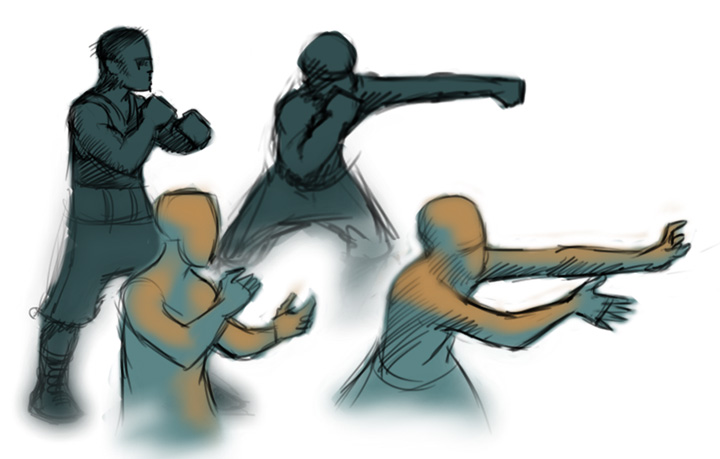
Fig. 2 - fighter and magician, ready and attack
As mentioned earlier, for the performance value, my entertainment spell will be woven gradually, built up over a short period of time. Along with the spell itself, the magician builds up the excitement and awe in the audience. In the video below, I'm stepping through the layers of this effect that works to rough animation of a magician's hands. I've animated the hands with a kind of weaving motion to suit the effect I've decided on.
video 36_majaqua
You may have just watched me design and animate an entertainment-style water spell, but this is just one application of a multitude of possibilities. This article has been a lesson in the process involved in designing and animating ANY magical effect. Starting with the crucial step of questions and answers before moving on to your designs and animation.
Feel free to use the files provided in the files folder for your own experiments