With the basics of surface tension on your tool belt, you can apply it to any liquid effect. In this lesson we're talking about thick, heavy liquid with strong surface tension and viscosity.
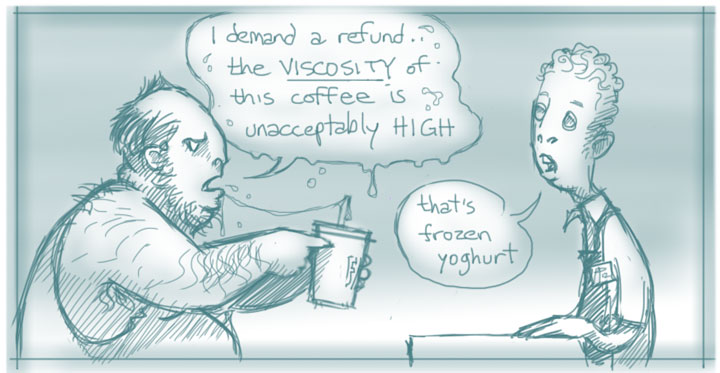
Fig. 1 - "Viscosity"; one of those words that always sounds a little pretentious in everyday conversation.
Generally speaking, viscosity is merely liquid thickness. Vegetable oil runs, drips and splashes with a relatively low viscosity compared to, say yoghurt which can be thick enough to stick on a vertical surface. Blood is thicker than water but thinner than honey. Viscosity also affects how the liquid runs, splashes, drips and pours.
In the video below, this pouring lava resembles toffee. Or maybe toffee resembles this lava.
..and how's this for surface tension?
We already have our foundation of surface tension, and when designing things like honey, mud, drool and lava, it's generally a matter of exaggerating that.
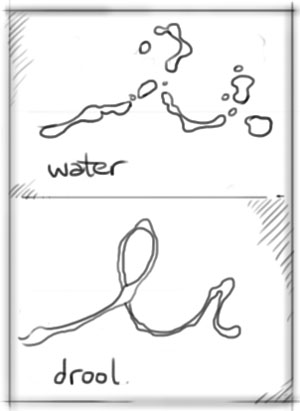
As Figure 2 illustrates, water has a lower viscosity so it readily breaks up from strings to beads. As you saw in the fountain lesson (0504), a string of water cannot travel very far before surface tension pinches it off into many pieces.
Drool however, like from a dog or some monster, is able to stretch further and further without breaking. The slow, heavy tension within the liquid means that volumes take longer break apart into beads. In the video below, those globules of drool aren't going anywhere.
Relatively thin liquids like blood and milk will spread very thin when spilled onto a flat surface. With thick liquids, volumes sit higher, piling on top of itself, rather than spreading.

Fig. 3 - Sitting heights of some liquids.
The video below shows 3 liquids: milk, olive oil and a thick chocolate sauce. The chocolate sauce is so thick that it piles up, rather than spreading. However, given enough time, it will spread some.
video 31_viscVar
You'll notice in the milk example above that on impact, many droplets break off and scatter. This is good evidence that it has a low viscosity compared to the oil and chocolate sauce, both of which would need a greater height/impact to break apart.
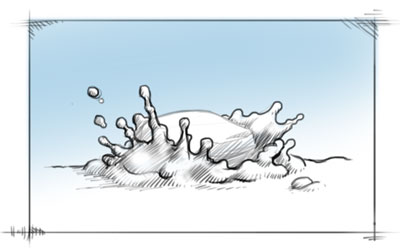
Fig. 4 - thick mud splash
In Figure 4 it's pretty obvious from the design that the splash is taking place in a thick liquid. While an ordinary water splash has finer, more elegant shapes, this is chunky and looks sluggish. Coming up in the timing section, we'll animate it with sluggish movement.
Just as we exaggerate the design of a liquid's surface tension to give it more viscosity, we do so with timing. Gravity of course, is unchanged, so free volumes will fall with ordinary gravity speed. However, the breaking and merging of beads, sheets or strings is what will be affected.
Another lava video below demonstrates the extreme end of the viscosity scale.
REALITY CHECK: Lava, being molten rock, is incredibly dense. If you toppled into a pool of lava, you wouldn't sink. You'd hit the surface with a slap and a scream before bursting into flames.
In the videos below, I'm demonstrating the timing of a few liquids with varied viscosity.
video 31_paint
video 31_drool
One good thing about animating ordinary water splashes is that they resolve pretty quickly, which is fortunate for such a massively complex effect. Heavy mud, however, while having a lower, easier splash design, the shapes resolve more gradually so the effect overall requires some slow-moving linework.
video 31_mud
With a foundation in other aspects of liquid effects, viscosity is a mere shift in their application. As you've just seen with mud, paint, blood and so on, all the hallmarks of liquid animation are there, but exaggerated depending on the thickness.
The vicious dog animation is in this lesson pack's files folder if you'd like to animate some drooooool on it.