Now and then we'll look at magical and stylised effects in the final lesson of the level. This time we'll be animating fire in the form of a magical fireball. Some rules of fire will apply, yet being magic, we get to decide which of those rules apply.
With magical effects we can do what we want. The main concern is to make it believable. We take a mundane phenomenon and make it unreal, applying our knowledge of real-world stuff, while also taking liberties with it.
When designing and animating magic, we start with realism, then build from there.
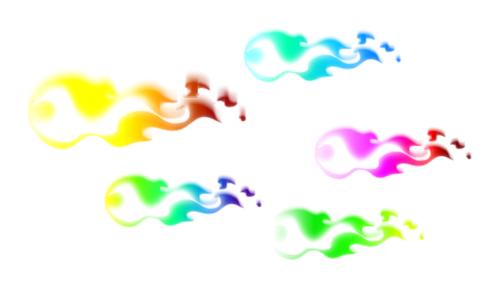
Brightness = heat. While there may be magical exceptions, fire generally needs to appear hot. In real world fire the colours we typically use to portray heat are a bright white-hot core with flames of yellow that become orange-red as they cool. Keeping that realistic look in mind, what can we do with colour to make fire magical?
For a start, almost any colour scheme apart from yellow-orange-red will look otherworldly. In each of these examples (Fig 1), the same fire is given a magical quality simply by changing the colour scheme, while still adhering to the real-world rule of brightness=heat (white core).
These fires are all the same, except for colour. The larger one may be more realistic in colour, but the others appear a little magical with the use of non-realistic fire colour.
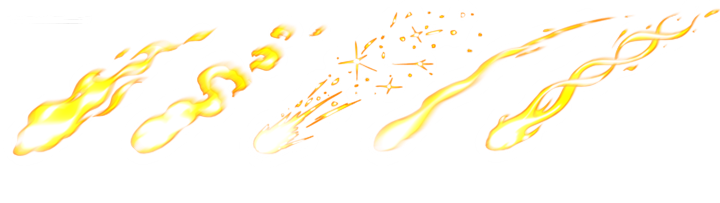
While you can get something magical just using colour, the most obvious design quality of magical fire could be the flame shape. In previous lessons we've seen plenty of realistic flames so we know how they should realistically look. Below are a few ways to alter their appearance by tweaking design of flame.
You may find it interesting to learn (if you don't know already) that in zero gravity, a candle flame is perfectly spherical. No, I don't have a personal zero gravity chamber in my office, but a quick YouTube search turns up a few videos.
A spherical flame is something one may have previously thought impossible but it's nice to know that our reality can surprise us at times.
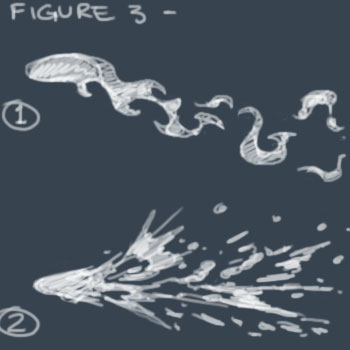
Fig. 2 - stylised behaviour
Flames always go up, right? What kind of a crazy universe would we live in if flames travelled sideways, downwards, oscillating or spinning toward dissipation? What if, as flames cooled, they fell like feathers? The world of magic is a crazy universe, so come up with a few ideas as starting points for your designs.
In figure 3 (left) I've designed two unique fireball behaviours. One has the flames falling as they dissipate, while another is a spluttering, sparkish design. Both of these will appear magical, even with realistic yellow-orange-red colouring.
What is your fireball made of? Is it something molten, for example rock (lava) or metal? Is there some kind of fuel source like oil that's magically created and burning? Or is it simply heat and flames generated from nothing? Considering these in your design will not only help you with the fireball's design, but also that of its creation, flight and impact. For example a ball of molten metal might smash into thick fiery fragments on impact, whereas a streak of burning oil may splash over a wider area.
The birth of a magical fireball may be instant, or perhaps it's a woven spell that builds up gradually. The first considerations are those of your project's needs. If you're doing this for a game, it may be necessary for the fireball to simply materialise fully formed so as to be instantly responsive to the player controls. If you're doing animation for a film however, you may have time to build it up gradually.
If it's an ignition, you could get some ideas from Lesson 19. Think of the substance, then decide how that substance is magically created/ignited. Does a sphere of oil appear before flame springs to life on its surface? Is it molten rock to which flames are a side-effect of the heat generated by the ball itself? A fireball of no real-world fuel source may simply appear with a flash, burning with ethereal flames. Take a look at the video below. Flint ignition appears as tiny white-hot beads that explode into a multitude of sparkles. It's a fascinating effect to watch, and one that's really quite magical, captured incredibly well here.
The design of a fireball projectile will appear different depending on certain factors, such as the substance, speed and trajectory. If it is weighty, it may be lobbed in an arc like a grenade. If it's like an arrow that flies straight to the target, the flame trail could be less complicated.
As previously mentioned, the substance of what the fireball consists should affect the design of its impact. Liquid fireball of lava or oil will both splash with different design. An insubstantial fire on the other hand may simply scorch, vapourising into soot, or thin air. Alternatively it may disappear completely as the target is engulfed in flames.
With a fireball, the behaviour of the flames may or may not behave like real flames. Again though, a strong foundation of realism is always a good starting point. It's often helpful to break down FX into small components in order to understand them. In the video below, I'm demonstrating a certain way of thinking about flame behaviour. You could break down smoke, steam, pixie dust or any other trailing effects in the same way.
video 32_fireAnim1
video 32_fire2
video 32_cycle1
When it comes time to animate your fireball, ask yourself how you can make it appear a little more magical. Must a fireball always travel straight or simple up/down like any real-world projectile? Why not curveball, pinwheel or some other crazy flight path?
A fireball is one of the most basic and common of magical fire effects. It's a nice little addition to your repertoire which, just like most other magical effects has its foundation in realism. In the assignments below you'll have a chance to mix and match behaviour, colour, shape and timing to come up with something special. From there, you decide how far to take the effect.
Easy: Animate a fireball cycle with a wobbling, molten head. Then add a flame trail and experiment with different flame timing and length to show flight speed
Medium: Animate a fireball igniting in mid air and flying away from camera in a curved trajectory.
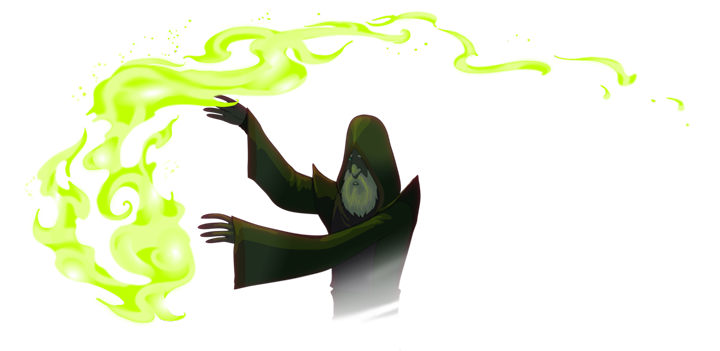
Difficult: Animate a molten orb hovering in the air with wide oscillations. Then ignite the orb and animate trailing flames. Apply a layer of embers emitted from the head of the fireball, as seen in the image above.