Nothing brings a background to life like a gentle breeze, but realistic grass animation can be difficult if you don't know where to start.
The smallest movement of a few flowers can liven up a whole meadow and you'll learn the easiest, most simple implementation of this effect. We're looking at a few techniques in this lesson, from simple flower-stalk swaying, to long grass bending and waving.
This lesson also sets you up for more advanced foliage effects like oscillating broad-leaf plants, which, due to their complexity of movement are nowadays mostly handled with 3D tools or simulations.
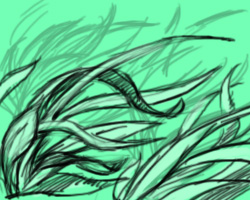
The key to animating this effect is understanding why the plant moves like it does. All too often animators heavily stylise wind-blown grass with too much wave motion, as if it's made of cloth (see Fig. 1). The reality is that most leaves have a supportive spine, veins that give rib-like support and a semi-rigid frame. This is why that flowing hair-like movement is more suited to seaweed, than everyday foliage.
All that flowing and rippling you see in feature animation might look lovely and dreamlike, but realistically, in a soft breeze reeds tend to flex and twist with an occasional gentle rocking motion. These motion layers of twists, tilts and oscillating all overlap, seemingly independent of one another. When it comes to grass, say up to 8 inches high, if you've ever watched it in the wind you'll notice that it flickers back and forth with very little apparent wave motion. This is very easy to do, yet it's rarely seen in 2D animation.
There are countless species of leaf, reeds and rushes each with unique shape and anatomy. With every shape and botanical structure comes a special way in which it moves, whether affected by a passing beast, falling droplet, breeze or gale. For an exaggerated example, we don't even need to talk about why a pine needle is different to a maple leaf. It's immediately obvious that the two will behave entirely differently from one another in the wind.
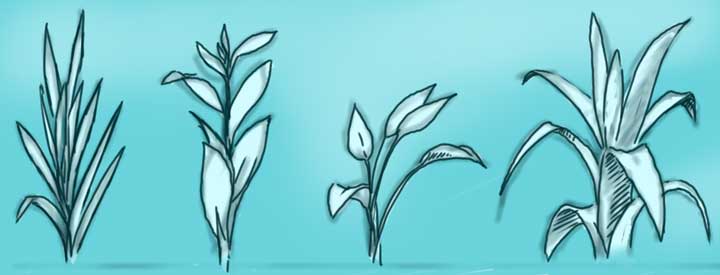
Fig. 1 - Various styles of foliage, each presenting its own set of challenges.
Later we'll be animating a couple of weedy plants with elongated, almost reedy leaves, so in the video below I'll design a few poses for this generic strap-like reed in a gentle breeze. Along the way we'll look at why the reed forms the shapes that it does.
video 28_intro
Exercise
Search for an interesting plant online and design a few key poses for animation.
This type of animation is for semi-rigid stalks with flower heads. If you think of a flower stalk with very little flexibility, you know that if it bends too far, it'll break. In the video below I'm setting up a couple of flower stalks for animation.
video 28_design2
For simple grass blades, you would have a slightly less complicated job than the flower stalks. At its most basic, a single blade of grass is little more than a strip of colour, so you can have a large variety of designs that potentially require very little animation line work.

I mentioned before that the dream-like flowing movement is better suited to underwater reeds. The kind of fast flapping grass and reed animation we've all seen in 2D animation is very well suited to blasting gales, like in the video below.
The treatment in the above video is extremely well done. But what if you just have an ordinary breeze? An occasional puff of wind? It won't do to have your grass thrashing about like crazy. So in this article, as always, we're guided by our love of realism and the foundation it provides for stylised animation. How about some gentle grass animation that we might see every day?
First up, let's look at the very simple jittering movement with no apparent wave motion. It's relatively simple to achieve this in digital software by keyframing rotation values.
video 28_lavenderBreeze
video 28_anim1
video 28_swayingGrass
The scene below shows a few finished flowers, each with their moving parts, but also notice there's a bit of 3D tilt going on. They occasionally lean towards camera, then away. Just a nice addition to give the scene some subtle depth.
video 28_flowers
In animation terminology, "overlap" means that one part moves, and the attached parts move the same with but with slightly delayed timing. For example, when a head turns, the hair follows a few frames later. You saw this in the previous videos, with the stalks moving, and the leaves following.
In the video below, I'm demonstrating the more frame-by-frame method of animating a reed with overlapping motion, using a whip as reference.
video 28_whip1
The video below shows the finished animation, with the gentle whipping frame-by-frame motion in the foreground, backed up by the simplified jittering peg (or tweened) movement.
video 28_grasses
Grass and reed animation doesn't have any particular digital FX treatment, but there's one effect that continues to elude FX artists; a windblown grassy field effect. Generally this is treated with a line of colour animating across a field, but it always manages to look "painty" and unrealistic.
From time to time over the years I've toyed with a realistic treatment for this effect, but it needs some work. If you fancy a challenge, why not try to come up with your own method?
While the various articles on wave-motion have provided you with a basis for animating flexible materials, be careful not to overdo it with grass and reeds, especially if you're aiming for realism. You've just seen (and I hope you practice) how to achieve more realistic grass animation. In later articles you'll learn more about how to apply and overlap these layers of motion to various other types of foliage, for something that moves in an incredibly complex way.
Remember that just because we're 2D animators, doesn't mean we are limited to the x and y axes. Remember that just as grass moves side-to-side, it also moves away and toward us. So once you have a pretty good grasp on flat, side-to-side movement, you should practice designing and animating with depth.