If you haven't already figured it out, this course so far is introducing you to effects and concepts that can be applied to other animation tasks. We're looking at principles that commonly underpin other natural phenomena. This week is all about flag animation, and how waves of energy travel through a medium.
Learning to animate wave motion in cloth sets you up for a huge range of effects animation. The principles in animating a flag are the same as those used in hair animation, rope, string, streamer, clothing, even some creatures.
In this lesson we're looking at flag animation and learning to move it realistically. However, because this isn't a specific effect, but a study of motion, we'll deviate slightly from our standard order of things and do a few warm-up exercises along the way.
We saw some wave motion principles at work in the Ripples lesson. Waves of energy travel, or propagate, in a direction until interrupted or dissipated.

Wave motion in a rope is similar to what happens in a flag
The wave motion of a water surface is very similar to that of a rope along the ground, a flag blowing in the breeze or a guitar string. Just like a cork on the water, rising and falling as waves roll by below, or the red paint on the chain link, patterns on a flag don't travel along with the ripples. We know they stay in the same place, oscillating with the wave motion.
In the rope/chain example, we see wave motion along the ground. In the following exercises however, we're removing the ground from the equation.
Exercise one:
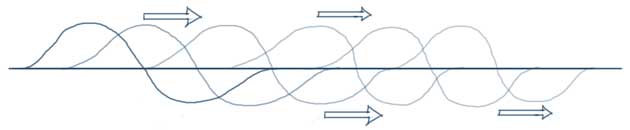
On a single layer, plot the movement of a wave along a single line (see Fig. below). This wave has a peak and a trough; that is, it goes above the line and below it
Exercise two:
Apply what you did in Exercise 1 to a short piece of animation. A single wave propagating along the line.
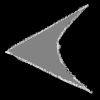
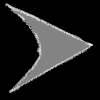
We've been looking at wave motion along a line, just like ripples. However, solid objects like rope, hair and cloth have a fixed length. Any curves or folds will pull the end back, as you can see in the images below.

The deeper the curves and folds, the more the point of this triangle flag is pulled backwards.
One of the most important aspects of animating props is consistency of volume. Flag animation is especially difficult because those volumes have flexibility through the flag, but not along, or across the flag. This is explained in the following video
The more complex the print on a flag, the more you have to worry about consistency. It's one thing to get the shape of the cloth correct on each frame, but another thing to add an intricate motif or image to those shapes.
3D animators can apply any image to a 3D flag with a minimum of fuss, but if you're a 2D animator, it's a true challenge in consistency. It may help to design a simplified image that's not so tedious and difficult to animate.
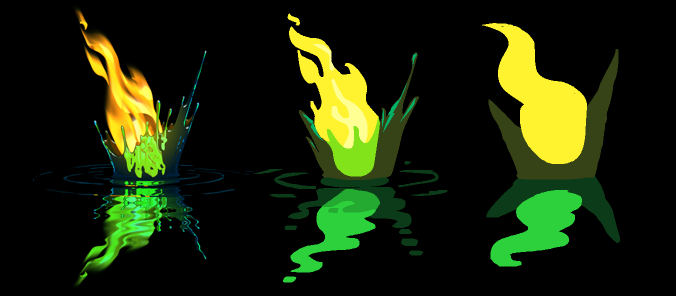
A complex image, with simplified versions for 2D flag animation
One great design exercise is to draw up a page of rectangles and just draw interesting flag shapes. Doing tons of these will help you come up with interesting shapes for later reference. The rectangular guides will help you keep the flag within its size limit.
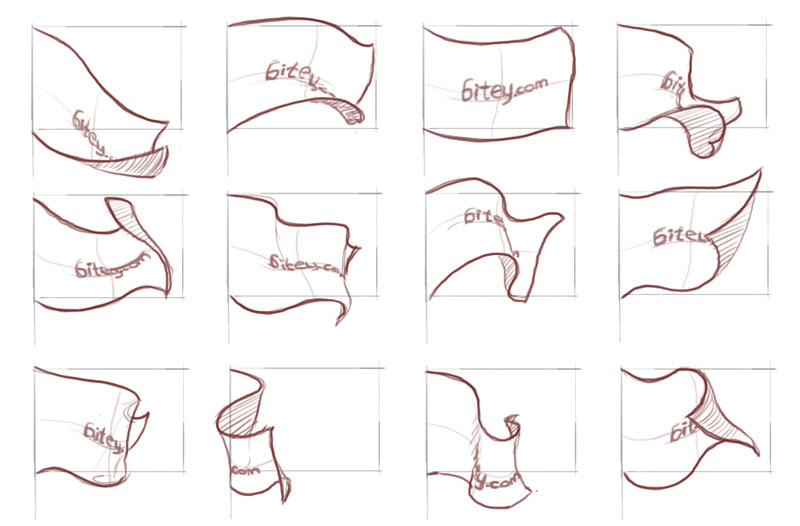
The ideal method of construction for a flag is to first draw the horizontal edges (i.e. top and bottom), then consider the fabric spanning between them.
[video file="06/flag_designDemo"]
When you're playing with flag shapes like those above, try to include some unexpected shapes, while at the same time keeping everything in the realm of possibility. Shapes coming toward and moving away from the viewer are especially interesting. All too often in 2D animation, flags are animated with a steady breeze, rippling with mechanical repetition. A more realistic approach would be to have the flag gently tossed by puffs of wind with many different and interesting angles and folds.
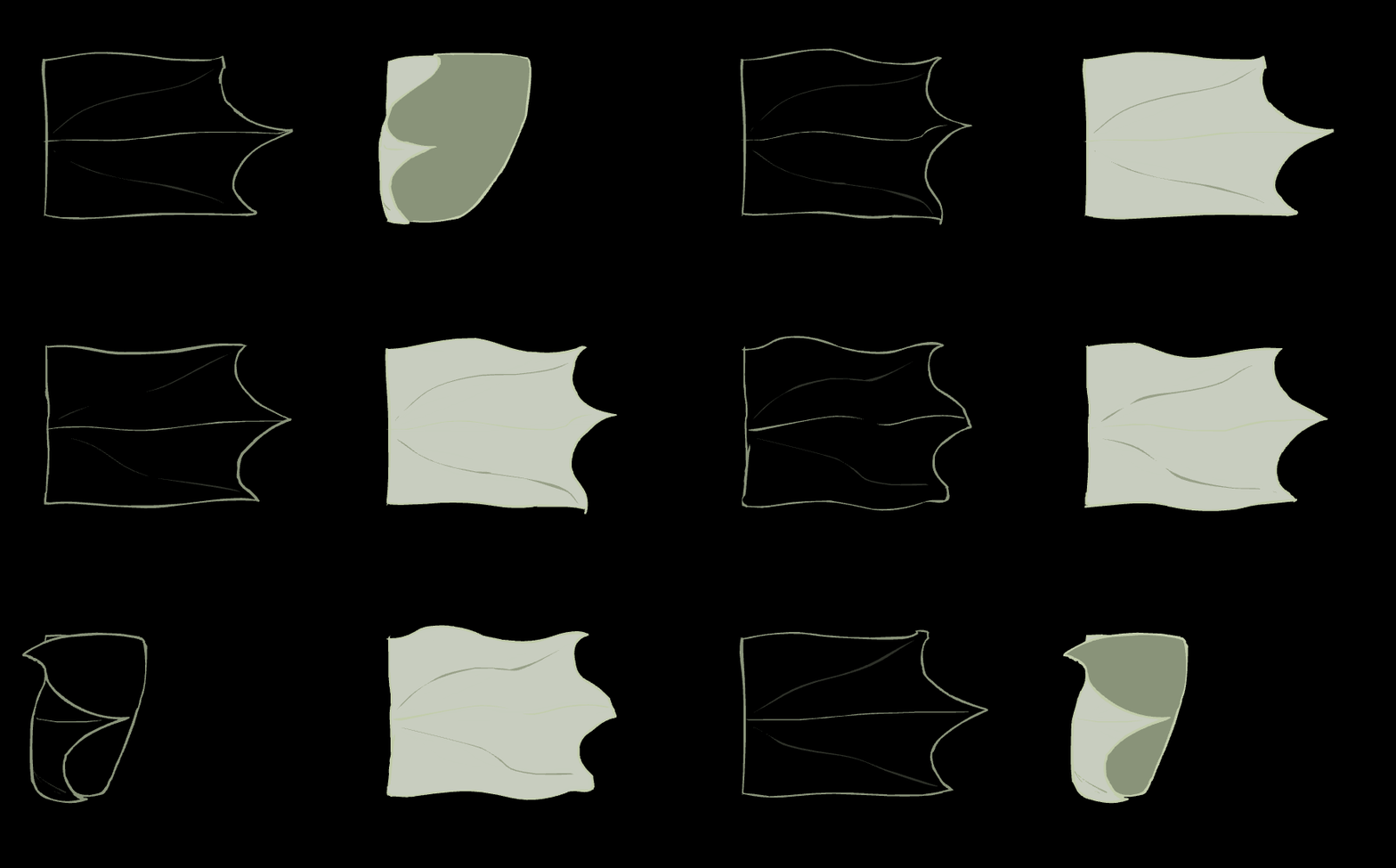
When you're designing these flags, try to picture them as hair, cloaks, ribbons, paper, even seaweed. It's not necessary to throw yourself into those effects just yet, but it's useful just reminding yourself that the same wave-motion principles apply to all of them.
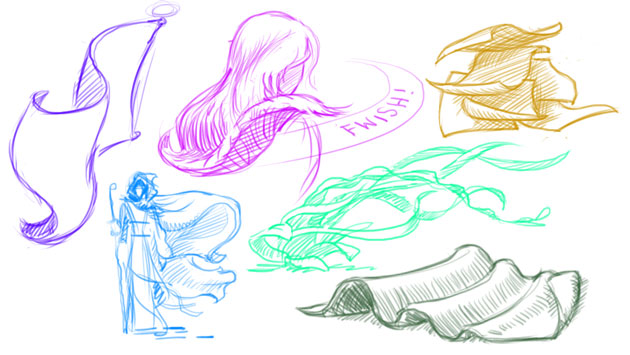
Wave design and motion applied to flexible solids
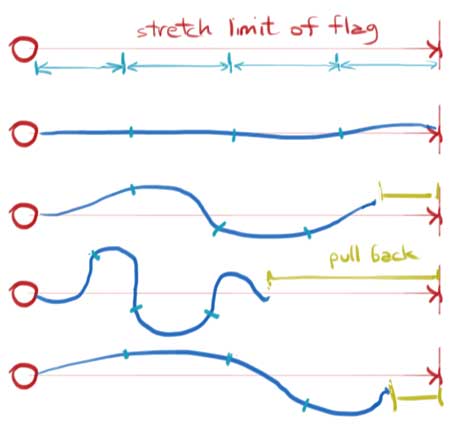
As mentioned in the video earlier, a flag is a flexible, but solid object and it doesn't grow or shrink. A careful animator will keep the volume consistent in each and every drawing. You can do this by thinking of the line in segments (chain links or train carriages) and keeping those at consistent lengths, frame-by-frame.
The best way for a beginner to learn flag animation is to first animate a single line wave. Splitting that line into a small number of intervals will help keep track of the volume, avoiding any gain or loss of material as it animates (see the Line Animation video, below)
When animating a full flag, it's a good idea to key out the motion using only the top and bottom edge lines. This process helps you get the movement right without too much effort. A beginner can make both top and bottom lines do very similar things, while an advanced animator can vary the two for more organic, realistic effect (see the Flag Outline video, below).
Once your rough horizontal edges are timed and working well, you can begin blocking in the outline of the flag. Chequering the flag roughly will also help with volume consistency and placement of any motifs or icon images. If you're really advanced, you can add folds and ripples to the vertical edges for even more advanced animation.
[video file="06/flag_LineExerc1"]
[video file="06/flagAnimation"]
Depending on the spacing of your drawings, you may find that you need to inbetween your flags. As mentioned in a previous article, timing will come with practice, but try to develop a sense for how far your flag moves from frame-to-frame. Depending on how your timing develops, you may feel comfortable animating entirely on single frames. On the other hand, you could find yourself timing your drawings on doubles (2s) or even 4s, requiring some inbetweening.
Whatever the case, there's no pressure here. If your flag timing works on singles; great! If it requires inbetweening, then you can simply inbetween it yourself, or have an inbetweener to do it. No big deal.
Animating a flag cycle may be done similarly to any other FX cycle. Considered design of the first pose, then inbetweening it with itself can work OK. However you look at it though, short cycles are cheap. The longer your scene, the more a cheap, short cycle will be noticed.
If you're having fun drawing various flag shapes, go nuts. Enjoy the key posing process. Use it to your advantage to animate the entire scene fully. If it's an exceptionally long scene, you could animate to halfway, then repeat it. Repeating the cycle just once is rarely noticed as a cycle.
One better way to animate a flag cycle might be to animate graceful, natural movement for several seconds, then animate your final pose (without forcing it) back into your first. Both types of cycles are demonstrated in the video below.
[video file="06/flag_cycles1"]
Try any of the following, depending on your experience. Post your efforts on the BCAFX Discord and I'll do my best to offer feedback.
Easy - As shown in the Timing section, animate a line with one end fixed, then have waves that travel from one end to the other. Be sure to maintain the volume of the line, as shown in the image.
Intermediate - Design and animate 2 seconds (48 frames) of a tattered flag blowing in very fast, blasting wind and loop the animation. The chaos of this effect should make it a slightly easier task than the Advanced assignment below.
Advanced - Design and animate 5 seconds of a flag that is tossed gently by an uneven breeze. Try lifting the flag with a gust of wind then have it settle gently before another weaker gust. Pay careful attention to maintaining the volume of the flag - don't let it grow or shrink.
Just like the previous articles, this one has been about studying a concept that underlies many, many different types of effects. As you have seen, understanding wave motion sets you up for almost any organic effect, whether it's water, string, hair, clothing or even a rippling arc of electricity.
I mentioned at the end of a previous article (Gravity) that you should make an effort to animate something falling, every chance you get. I think wave motion is another essential skill that must be refined by constant practice. Just the string exercise alone will help you understand the concepts and master the movement.