Many traditional FX animators place destruction at the extreme end of the 2D FX complexity scale. A single object can present its own challenges, but when that single becomes many, each of which requires thoughtful, considered animation, the difficulty of the job is greatly amplified.
In this lesson, as a destruction introduction, we'll be animating a smashing terracotta vase. The vase itself will have a simple design, but will become complex suddenly at around frame 12!
Fractures in solid material such as glass, concrete and in this case, terracotta requires a bit of creative design work. It's all too easy to make every shard and crack look similar (remember the Twinning lesson). This can be a desired effect in some instances - such as safety glass that shatters as many small beads, or a brick wall that breaks down into many identical bricks - but in most cases, you'll want to incorporate some variation into your shard designs.
Your first stop really should be an image search online. Just a quick search using the broadest terms like "broken glass" immediately turns up some inspiring reference images.
In an image search, you'll see lots of glass and other materials. You can see how different types and thicknesses of materials produce their unique fragment shapes. Images like these are perfect reference and a good place to start when designing fragments for your scene.
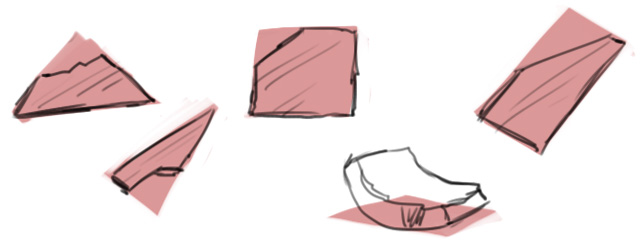
Fig. 1 - using primitive shapes (red) as basis for shard designs
When designing shards of a shattered solid, I like to start with a number of primitive shapes, and work from there. Primitive shapes are much easier to animate than oddly shaped puzzle pieces. The video below looks at that design process for our terracotta vase.
video 39_vaseDesign
The initial smash of a shattering object can be surprisingly contained at times, or on the other hand, quite explosive. The initial outward spreading of fragments is generally quite sudden, especially if the impact is on a very hard surface, and/or the fall is from a decent height. The integrity of the object will also play a key role in how far the fragments travel after impact.
A very thin-walled object, like an eggshell or light globe, breaks very easily because the material is comparatively thin. However, the same sized object with thicker walls may take a greater drop-height to smash. As a result, all the energy it took to shatter is much greater, and all that energy is transferred to the individual parts after fracturing. You can see then how a thicker-walled object may have a more explosive smash.
I remember when I was a kid, doing stupid things as kids do, I climbed a massive water tower in my home town. From the top I dropped a coke bottle onto the tarmac below. Climbing back down to investigate, I found the bottle to be little more than a pile of white powder. As thick as the glass had been, the force of the impact had literally pulverised it.
Drop height, object weight, thickness; all these things and more play their own part in how an object will smash.
In the videos below, we'll look at our smashing flask and how the fragments not only travel, but also tumble and settle.
video 39_flask
video 39_flaskFinal
As far as animating destruction, smashing a terracotta vase is a very simple example but it's a great start. It'll be a good experience to draw on when some day you need to animate some incredibly complex destruction, such as a shattering pane of glass or a crumbling building.
I'm showing the below video again (I showed it earlier in the Invention lesson) because it was the first time I tackled a major destruction scene. The window shattering scene (at approx 0:25) took me a couple of weeks. There are hundreds of coin-sized fragments tumbling in semi-slowmo. I relished the challenge and am still fairly proud of the result, especially considering that nowadays it'd be crazy to suggest using hand-drawn 2D animation. It's a given that this scene today would be handled with 3D.
As you've seen, a smashing vase incorporates one other aspect of FX that you've studied previously, namely gravity timing. The initial speed of the drop aside, each individual piece needs to tumble, bounce and settle realistically. This will be easier if you've been practising your gravity timing in other FX throughout this course, from water splashes to swinging ropes.