The world of lighting effects is vast, but what you know already can help you add stunning depth and quality to your work. This time we're studying what's known as the penumbra. It's the fuzzy edge of a shadow and we want to understand what, how and "why should I?"
This lesson is all about how something looks rather than how it moves. The Timing section therefore will consist of just an exercise or two.
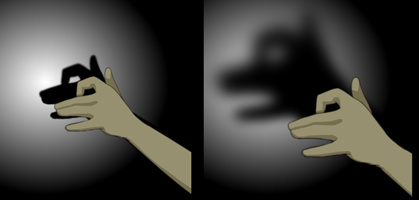
The fuzzy edges of a shadow or pool of light is known as the penumbra. It exists because the light source is has area of breadth, width or a radius.
In a scene where the light source is an infinitely small point, all shadows are perfectly crisp with no soft edges. However, in reality, there are no infinitely small point lights. All light sources have area dimensions, like a radius, width or breadth.
The sun, for example is a disc with a radius. In any scene, the size of this disc relates directly to the fuzziness or crispness of any shadows. A light bulb also has width, as does a candle flame, a bolt of lightning, or a ceiling skylight. None of these are infinitely small pinpricks of light.
In our world, all lights have dimensions. For a simple experiment, turn on the light in your room, then place your hand on the wall. With an average sized light bulb, the shadow under your hand should be relatively sharp. However, as you move your hand toward the light, the shadow becomes fuzzier as it grows larger.
In figure 2 (right), the pencil shadow is sharp where it touches the wall, but it gradually softens as its distance from the wall increases. If the light source was smaller or further away, the shadow would be more crisp. If the light source was larger or closer to the pencil, the shadow would be more blurred. Note that the point of contact with the wall will always have the sharpest part of the shadow, regardless of the light's size or proximity.
In the video below, we'll look at how the size of a light source determines the penumbra.
video
The sky can be one large source of diffuse light. On an overcast day, shadows under people and objects are fuzzy because the whole sky is the light source. To visualise how this works, let's take a look at an example of an area light source.
For the sake of this example, imagine the inside of a windowless room. It's pitch black inside. Now imagine a large square skylight is opened in the ceiling.
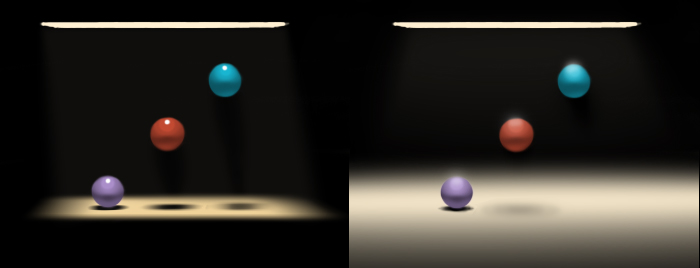
Fig. 3 - Left: direct sunlight - Right: diffuse sunlight
In figure 3 above, the left image shows the sunlight streaming through the skylight. On the floor is a square patch of bright sunlight with fuzzy edges. The shadow of the ball closest to the floor is sharper than the others but they all have fairly well defined shadows and crisp highlights. Now cover the skylight with a large, single sheet of white paper (right-hand image). The light no longer streams directly through the square skylight but instead, the paper itself is now the light source in this environment.
The light source is no longer strong and direct from the sun's small disc. It's diffused over a wide area. Under the skylight now, the ball shadows are also diffused and the blue ball's shadow is pretty much gone. Even the ball resting on the ground has a fuzzy shadow.
On an overcast day, the exact same thing happens. The cloud is diffusing sunlight, just as the paper did. The further an object is from a surface, the greater this diffusion. Figure 4 illustrates how light rays, when scattered, can reach underneath an object, and shadows can bleed out from underneath.
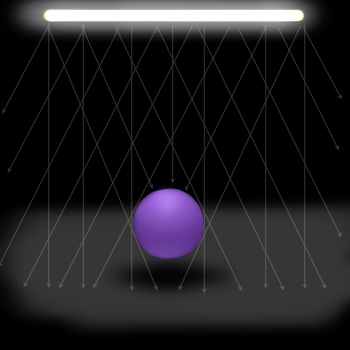
Fig. 4 - object interrupting scattered light rays
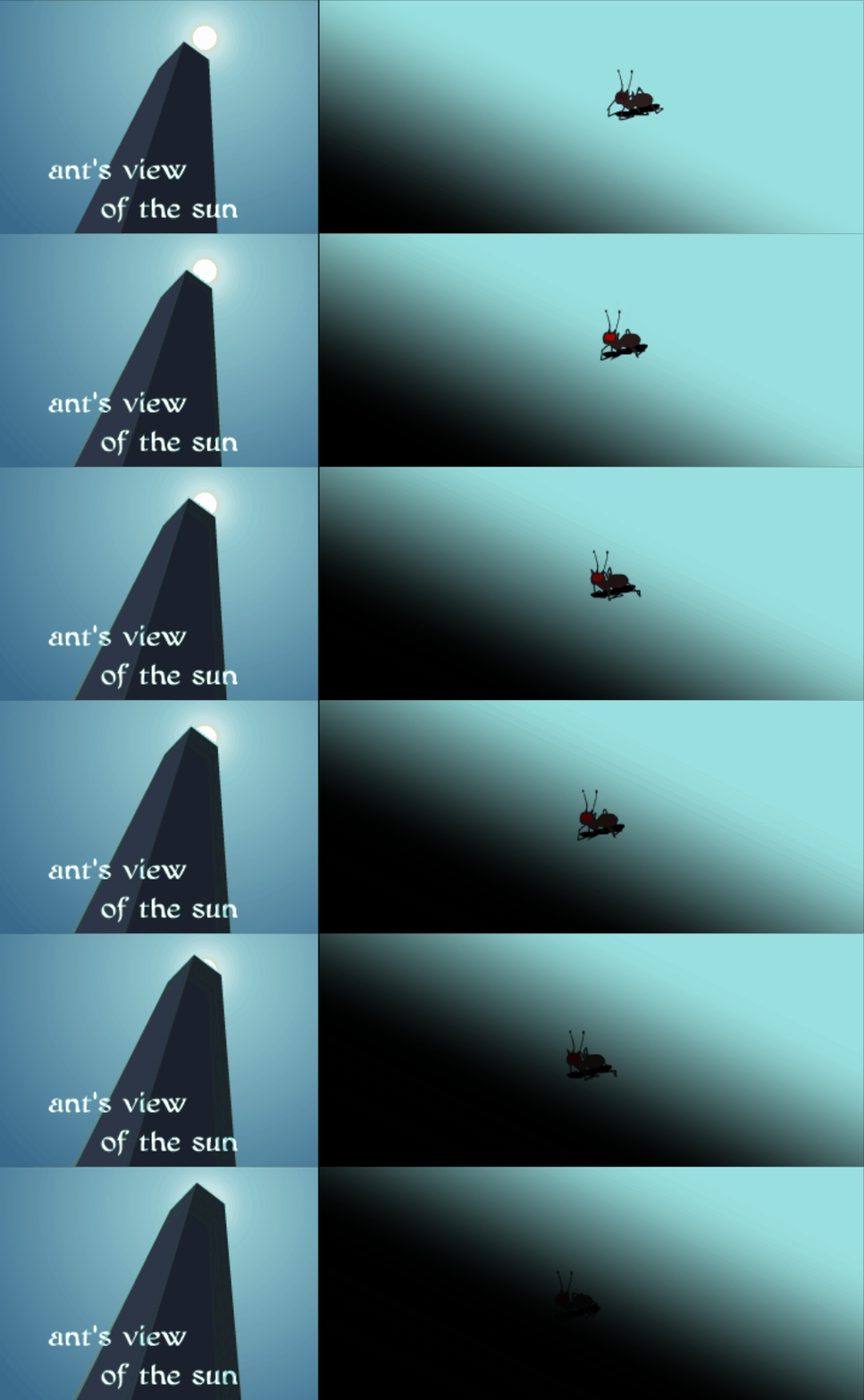
Let's look at it another way. The ant below is walking into a shadow. As the light source is gradually obscured, there becomes more and more shadow. This gradual obscuring of the light is the reason the shadow appears fuzzy. When the sun is half obscured, there is only half as much light reaching the ant. When the sun is fully obscured, he's in full shadow.
In digital animation, you may animate the penumbra values if the light source is moving in relation to an object, or vice versa. This movement causes change in the shadows, for example moving your hand closer to a candle and watching the shadow grow larger and blurrier. A more subtle example might be the soft movement of foliage and how it casts dappled shadows.
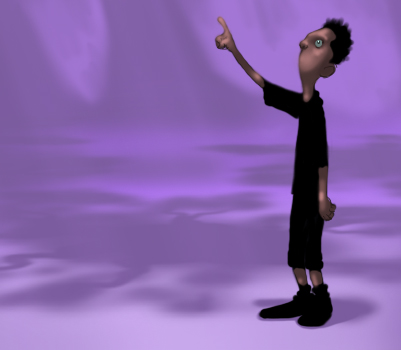
Fig. 5 - dappled foliage shadows
In figure 5, there are dappled shadows and a character shadow, each with different blur values consistent with the proximity of objects to the ground. The foliage has more blurred shadows because the foliage is further from the ground. The character shadow is sharper, especially near the feet.
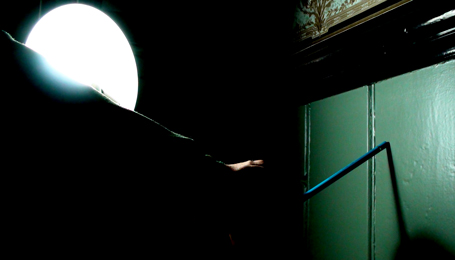
Example 1 - The pool of light from the swinging lamp below has softer edges on the extremes, and is nice and sharp at the bottom of the arc.

You've learned that the penumbra is the gradual increasing of light or shadow. Thinking of your ground shadow in terms of how an ant might see the light source is a useful technique for visualising the penumbra.
Most often, good lighting in 2D doesn't always mean a painfully tedious process of lighting construction. But when the day comes, it's always helpful to know how these things work. With the what and how in your toolbox, it's only a matter of deciding why, or when you should use this particular aspect of lighting effects.